
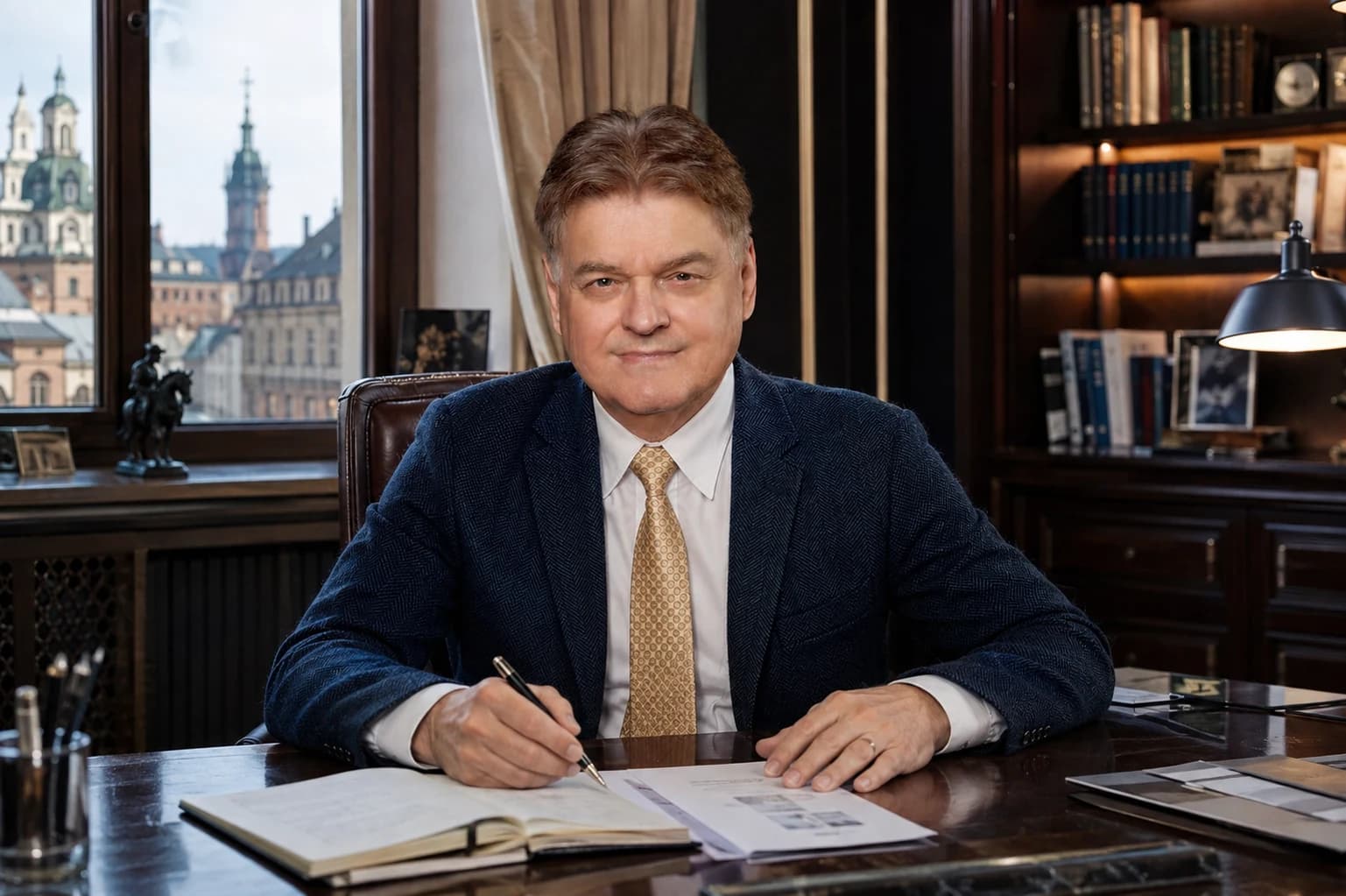
There is a number Tadeusz Kowalski returns to more than once, and it is not a revenue figure.
“Three hundred and fifty-one,” he says. “The average headcount of a service centre in Kraków — thirty per cent above the national average, the highest in Poland.” He lets it sit. “Now ask me how many centres opened last year.”
The answer, from the Association of Business Service Leaders, is forty-six across the whole country, with four more in the first quarter of 2026 — the slowest pace of new openings in a decade. Poland’s business services sector employs just over half a million people across 2,179 centres. Kraków accounts for around 108,000 of them, more than any other Polish city.
“The sector stopped growing outwards. It is growing upwards,” he says. “Nobody is going to walk into Kraków and hire another twenty thousand people. The work now is making the people already here worth more. That is not a recruitment problem. I spent my career on recruitment problems. This one is different.”
Archangelsk, London, Utica
His mother was deported to a labour camp in Archangelsk, on the White Sea, in the Soviet mass deportations of Poles. When she was released she made her way west; the family arrived in London as refugees, where he was born. Within two years they had moved again, to Utica in upstate New York — then a serious Polish city in a way that is easy to forget now.
At the table they spoke Polish. Outside it everyone learned English quickly, because that was the arrangement. His father spoke Ukrainian, Hungarian, German, Polish and English, not as an accomplishment but as a consequence of where he had lived.
“People say languages run in a family, as though it were the eyes,” Kowalski says. “It is not genetic, it is circumstance. My father spoke five languages because five armies came through. Nobody in that generation was collecting them for pleasure.”
My father spoke five languages because five armies came through.
Further back the family were Galicians — which in the nineteenth century meant Habsburg territory running from Kraków east to Lwów — and they had people at both ends of it. The eastern side, around Lwów when Lwów was Polish, is the ancestral heartland. The Kraków side married into the Helcels.
Ludwik Helcel was a banker and a vice-president of Kraków; his wife Anna endowed in her will the almshouse on ulica Helclów that has been taking in the city’s poor for well over a century and is doing so still. She also paid for the Chapel of the Resurrection at Rakowicki cemetery and gave it to the city, keeping back only the crypt beneath it for the family. Behind them, on the Austrian side, were the von Traubenbergs.
Kowalski volunteers none of it, and is flat when asked: “everyone from that part of Europe has a great-grandmother who lost something.” Then he offers, unprompted, the one detail he thinks matters. The founders attached a condition to the crypt. Only family members who still spoke Polish could be buried in it.
“I have thought about that more since starting the school than I ever did before,” he says. “They were bankers, in a city that had been partitioned out of existence, and what they wrote into the deed was the language. Not the money. They assumed the money would look after itself. They were not certain the Polish would.”
What they wrote into the deed was the language. Not the money.
The only person who has to talk to everybody
He read Philology and Sociology on a combined programme split between the United States and Europe, then took a Business Studies diploma with honours — a combination that looked, at the time, like indecision. “I wanted to know how language worked and how organisations worked. It took me thirty years to find the job where those are the same question.”
The career that followed was built almost entirely outside Europe, on one recurring problem: how to make a workforce of a dozen nationalities function in a single shared language. It began in Saudi Arabia in 1989 on the Saudi Strategic Storage Project — sixteen billion dollars, twenty years of excavation, a workforce past twelve thousand and a sixty-million-dollar departmental budget answering to him.
After that the assignments changed continent but not shape. Three thousand people recruited in twelve months in Manila. Human resources stood up in a theatre of war for Halliburton KBR in Iraq from 2003, down to the charter flights that rotated staff between Dubai and Bagram. Sixty thousand employees at a Kazakh mining group. Oil in Libya, mines in Mauritania and Guinea. In every one of them he was the person in the middle — between the ministry and the camp manager, the union and the board, the Filipino electricians and the Swedish engineers.
“You pick up languages when you are the only person who has to talk to everybody,” he says. He has Polish and English natively, Russian, French and Tagalog fluently, and enough Arabic, German and Spanish to be useful. “I was not being cultured. I was being useful.”
Kyiv, the winter of 2023
His Polish consultancy work ended that December. Before the next assignment began he went to Kyiv — a short engagement building out a charity, taken at speed and never added to his CV. It was the winter the Russian strikes on the grid were at their heaviest.
“You learn what an organisation actually is when the power is off,” he says. “We were hiring people with doctorates to do logistics, because logistics was what there was. Extraordinary discipline. And every funding conversation, every donor call, every co-ordination meeting with an international agency was in English, all of it consequential — and a great many very capable people were losing ground in those calls for reasons that had nothing to do with their competence.”
He came back with a thesis he has not moved off since. Around a million Ukrainians now live in Poland under temporary protection; seventy-eight per cent are working, the highest rate in the OECD. In 2024 they generated 2.7 per cent of Polish GDP and over fifteen billion złoty in taxes and contributions.
“And a great many are working below their qualifications — that is the polite phrase. When reconstruction starts it will be the largest procurement exercise in modern European history, run in English between people whose first languages are Ukrainian, Polish and German. Poland is the staging ground for all of it.”
The interview
You hired tens of thousands of people. What did you keep seeing?
The same person, over and over, in different countries and different job titles — men and women both, because the pattern was never gendered. Excellent at the job, certificates on the wall. And in the room where the decision got made, they could not put a sentence together that landed.
Their English was often good. Grammatically better than the native speaker across the table. It was the other thing. They could not deliver a difficult message without it sounding like an accusation, or disagree with a client and keep the client, or say “that timeline is not realistic” in a way that made them sound senior rather than obstructive.
And that is teachable?
Entirely. It is simply not taught. That is what took me years to accept — that this was a gap in the market and not a gap in the people. And it needed a school, not a consultancy. I have been the consultant who advises and leaves; the report goes in a drawer and the same capable person is still not promoted.
Poland ranks fifteenth in the world for English proficiency. “Very high.” Is there a market?
That statistic *is* the market. If the whole workforce is very high, then very high is the floor — the entry requirement, not the advantage. Nobody in Kraków is hired for speaking English any more. They are hired despite everyone else also speaking English.
So where does the margin go? To whoever can chair the meeting, hold a position under pressure in a second language, tell a German client the number is wrong without losing the account. A country full of B2 speakers is exactly where a school like ours becomes necessary. Somewhere nobody spoke English, we would be teaching the alphabet.
Nobody in Kraków is hired for speaking English any more. They are hired despite everyone else also speaking English.
Why Kraków?
The numbers are right and the city is the right size to start in. A hundred and eight thousand people in business services, the largest centres in the country by headcount, and a sector that has publicly shifted from adding people to raising the value of the people it has — that is our customer describing our product in their own annual report.
And it is dense. One cluster, walkable, the decision-makers in three districts. You can build a reputation here by doing good work, because word crosses a city this size in months. In Warsaw it would take years and a great deal more capital.
Why these professions first?
We follow the payroll. Finance and accounting operations, customer operations and human resources are the three largest process families in Polish service centres. That is where the people are, and where getting the English wrong costs the most per incident — a mishandled escalation, a grievance meeting that goes badly, a client call that ends in a complaint.
Sixteen professions are specified and the first courses will be finished for the day we open. The rest follow demand. If a bank tells me it needs forty people in trade finance ready by March, that is a signal — and the architecture is built so a new profession takes weeks, not a rebuild.
What makes the teaching different?
It comes straight out of assessment work, which is what I actually did for a living. If you want to know whether someone can do something, you do not ask them about it. You put them in it and watch.
So every lesson is ninety minutes in seven stages, and the fifth — twenty minutes of live, timed, unrehearsed production with a consequence attached — is never cut. That is a rule, not a preference.
Between sessions there is no homework. There is a Field Task: ten minutes performed in their actual job that week — use the thing we practised, in a real meeting, then tell the room in two lines what you said and what happened. And they bring their own emails, decks and escalations, anonymised. Their work is the syllabus.
Groups are capped at eight. Above that the speaking time per person falls below what the fee justifies, and we would be selling a lecture.
Someone will call it a finishing school.
They do. I am not in love with the phrase — it suggests deportment and napkins. But the useful half is true. These are finished professionals; nobody arrives here to learn English. They arrive to acquire the last five per cent that decides whether the room defers to them. If it means polish on something already substantial, fine. If it means etiquette lessons, we are not that.
And after Kraków?
The method does not care what country it runs in. The vocabulary changes; the architecture does not. Prague, Bucharest, Vilnius, Lisbon — the same sector with the same problem.
And then, I think, recruitment — but specialised, not general. I have no interest in competing with the agencies who move volume; that market is served and the margins are thin. I mean the narrow end: a Ukrainian actuary, a treasury accountant with real IFRS depth, someone who can genuinely run a European escalation. Roles where forty people in the country can do it and the client cannot find one of them.
A school is an unusually good place to find those people — we see candidates for sixteen weeks under pressure, and you learn more in one difficult role-play than in four interviews. But it comes after the teaching is beyond reproach. Get that order wrong and you are an agency with a classroom attached.
The floor above the street
Windsor Academy runs from Krupnicza 14, ten minutes from the Rynek. Classes are four to eight, and there is no marketing language about immersion or confidence.
“Confidence is an output,” Kowalski says. “You do not teach it. You give somebody a sentence that works, they use it on Thursday, it works — and the confidence arrives on its own. Anyone selling you confidence directly is selling you a feeling.”
He still takes assignments abroad between cohorts, and the question of stopping does not appear to have occurred to him. “I have built HR departments on four continents and closed a mine down to the last employee. This is harder, and I am enjoying it more. Those were logistics. This is whether a person walks out of a room having been taken seriously, and there is no procedure for that. You have to actually teach it.”
There is one more thing, and he does not raise it.
The mark at the head of the school’s letterhead is a small classical facade: a pediment, a central arched door, two arched windows either side, an open book beneath. It is not a generic schoolhouse. It is drawn from the Chapel of the Resurrection at 26 Rakowicka Street — the building Anna Helcel paid for and gave to Kraków, above the crypt she kept back for the family, on the condition that they had kept the language.
Asked about it, he is unwilling to make a speech.
“It is a door, two windows and a book,” he says. “People can read into it whatever they want. It also happens to be the building the family gave the city, over a crypt you could only be buried in if you had held on to the Polish.” He shrugs. “That is not going in the brochure.”
Цей матеріал опубліковано лише англійською. Решта сайту й усі наші курси доступні польською, українською та російською.